How to find hidden cameras in an Airbnb or hotel room
How to find hidden cameras with a flashlight, your phone and the Wi-Fi list, what research says about detectors, and what to do if you find one.
In 2024, Airbnb changed a rule that had been in place for years. Hosts used to be allowed indoor cameras in shared spaces like living rooms, as long as they were visible and disclosed. From April 30 that year, every indoor camera was banned, worldwide. Around the same time, CNN reported that the company had logged roughly 35,000 customer support tickets about surveillance devices over about a decade.
Neither fact means your next rental is bugged. Most are not. But if you want to know how to find hidden cameras when you arrive somewhere new, you do not need a spy kit. You need ten minutes, your phone, and an honest idea of what each method can and cannot catch. That last part is where most guides fall short, so this one leans on two research papers that actually measured it.
How common are hidden cameras in rentals?
Nobody publishes a reliable rate. Platforms do not release the numbers, and police statistics rarely separate a camera in a vacation rental from other voyeurism cases.
The closest thing to a figure came out of CNN’s 2024 investigation, which went through more than 2,000 pages of lawsuits and police records. In a deposition, an Airbnb representative said the company had generated about 35,000 support tickets about surveillance devices since December 2013. Airbnb pushed back on what that number means: one report can create several tickets, and some involve things like a faulty doorbell camera. The company did not say how many were genuine finds.
So the number is not a probability. It does show the issue is more than an internet scare. Airbnb’s own announcement in March 2024 noted that the majority of its listings do not report having a security camera at all. A quick check on arrival is sensible, in the same way you glance at where the fire exit is.
Where hidden cameras are usually hidden
Someone who wants to film guests needs a view of the bed, shower or toilet, a power source that lasts, and an object nobody looks at twice. That narrows the search a lot. In the cases CNN reviewed, cameras were hidden in, among other things, a phone charger in a bedroom and a clock radio pointed at the bed.
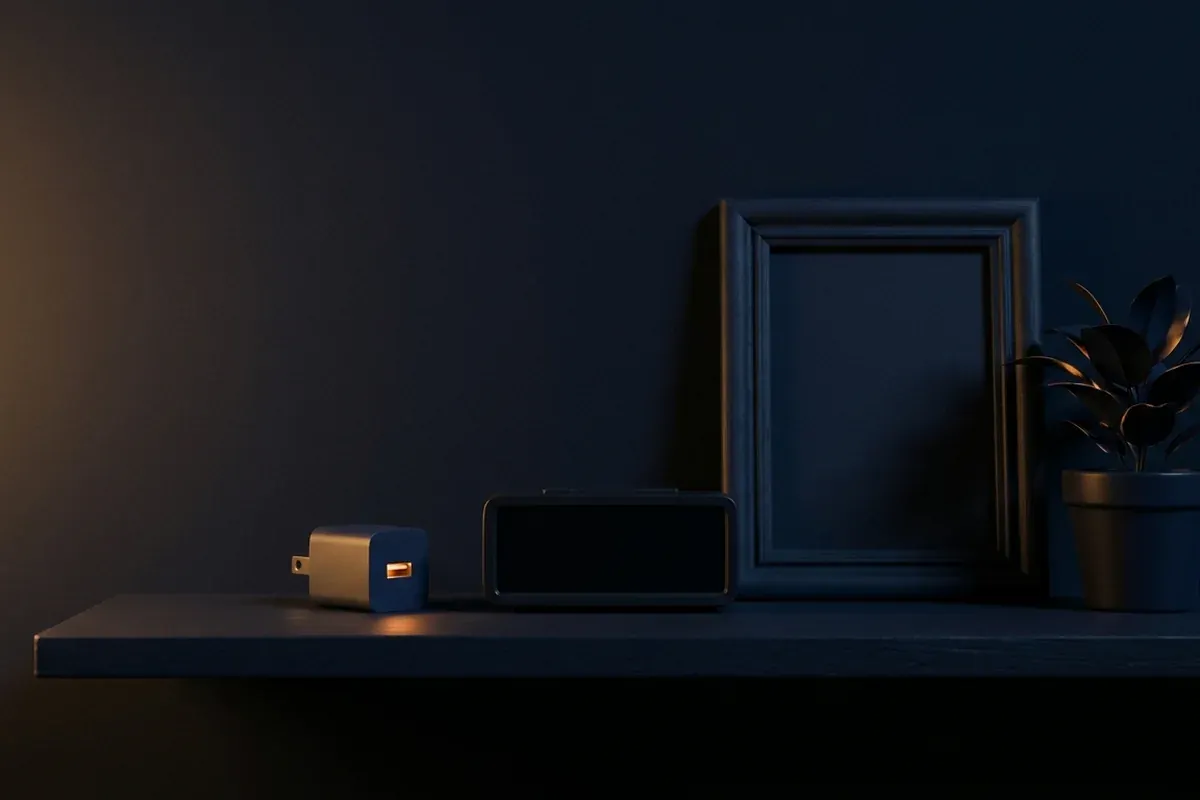
| Object | Why it works for hiding a camera | What to check |
|---|---|---|
| Smoke detector | on the ceiling with a view of the whole room, nobody touches it | a second detector in the same room, one above the bed rather than in the hallway, a small dark hole in the middle of the casing |
| USB charger, plug adapter | always powered, often near the bed | a charger already plugged in with nothing attached, no brand name anywhere |
| Alarm clock, clock radio | sits on the nightstand facing the bed | a dark front panel, angled straight at the pillow |
| Router, TV box, smart speaker | blinks anyway, has power and network | a device in a bedroom or bathroom where it has no technical reason to be |
| Picture frames, decor, plants | can be placed anywhere | odd angles, holes that serve no purpose |
| Air vents, lamps, mirrors | built in, guests leave them alone | fresh screws, glue residue, a cable that goes nowhere |
None of these objects is suspicious by itself. Every rental has a smoke detector and a charger. What should catch your eye is something placed where it makes no sense, or something aimed exactly where you undress.
How to find hidden cameras in 10 minutes
The order matters. First work out where a camera would even be useful, then check those spots carefully. Searching every square inch of a room takes an hour and does not find much more.
1. Map the sightlines. Stand by the bed, in the shower, at the toilet and wherever you would change. From each spot, note which objects have a clear view of you. Those are your suspects. A smoke detector in the hallway is not interesting. A clock aimed at the pillow is.
2. Look closely and pick things up. Handle the objects on your list where you can. Does the charger have a brand and the usual markings? Does the clock feel hollow? Is there a hole smaller than a pinhead that has no function? The Singapore researchers we cite below describe lenses in these cameras as small as 1 to 2 millimeters across, usually sitting in a dark surface.
3. Lights off, flashlight on. Make the room as dark as you can. Hold your phone’s flashlight right next to your eye and sweep the suspicious spots slowly. A camera lens bounces light almost straight back to its source, an effect called retro-reflection, the same thing that makes a cat’s eyes shine. You are looking for a tiny, sharp, bright point. Angle matters: according to the researchers, the reflection is only visible within a narrow cone of about 20 degrees. Move around, try several positions, and do not panic over every glint, since screws, lacquer and glass shine too.
4. Use your phone camera to spot infrared. Many cameras built to record in the dark use infrared LEDs. Your eyes cannot see that light, but a phone camera often can. NASA explains it with a TV remote: the remote’s infrared beam is invisible to you, yet some digital and phone cameras pick it up. Do that test first. Point a remote at your phone camera, press a button and see whether a dot lights up on screen. Try both cameras, since often only one of them sees it. Then sweep the dark room with whichever camera worked.
There is a catch. Infrared LEDs around 850 nanometers give off a faint red glow, while those around 940 nanometers show little to none, as the security lighting maker AXTON explains in a technical brief. A camera without night vision has no LEDs at all. Finding nothing is a good sign. It is not an all-clear.
5. Check the Wi-Fi list. Open your phone’s Wi-Fi settings and look at the networks in range. An unknown network with a strong signal right inside the rental, especially one whose name sounds like a camera brand, is worth a question to the host. If you are on the rental’s Wi-Fi, a network scanner app can list connected devices, and many show the manufacturer based on the start of each device’s hardware address. Our guide to the MAC address explains how that works.
The limit: a scanner only sees the network you are on. A camera on a second network the host set up will not appear. And the Singapore paper points out that many small cameras simply record to a memory card to save power. They transmit nothing.
6. Glance at Bluetooth. Turn Bluetooth on and see what shows up nearby. Cameras rarely use Bluetooth, but an unknown device near the bed is worth a look. Trackers such as AirTags are a separate case with their own alerts on iPhone and Android, covered in AirTag found moving with you?.
Do hidden camera detectors work?
This is one of the few questions in the field that someone has actually tested. In 2021, researchers from the National University of Singapore and Yonsei University built 30 everyday test objects and hid a camera with a lens of about 1.5 millimeters in nine of them. Because of pandemic restrictions, they recruited 379 participants online, who watched videos of the objects, filmed either normally or through the viewfinder of a common optical detector with red LEDs, and marked where they thought a camera was. The team compared that with its own prototype app, called LAPD, which uses the depth sensor in some Android phones.
| Method | Hidden cameras found | False alarms |
|---|---|---|
| Naked eye | 46.0% | 54.9% |
| Detector, blinking LEDs | 57.7% | 35.2% |
| Detector, steady LEDs | 62.3% | 26.9% |
| LAPD research prototype (depth sensor) | 88.9% | 16.7% |
So by eye, people found just under half of the cameras, with a detector about six in ten, and with the research app close to nine in ten.
Two things stand out. Even with a dedicated detector, people found only about six in ten cameras, and that was after the researchers made sure the reflection was clearly visible in every video. And every method that relies on human judgment produced a lot of false alarms, because a shiny button through a red viewfinder looks a lot like a lens. LAPD did best, but it is a research prototype, not something you can download.
The other kind of detector, the RF type that beeps when it picks up radio signals, has a different problem. In a rental full of routers, phones, smart TVs and Bluetooth speakers, it beeps at everything. And it stays quiet for a camera that records to a memory card and never transmits.
A 2022 paper from Carnegie Mellon University looked at the wireless side more seriously. Its system, Lumos, identified 44 different Wi-Fi devices across six test environments with 95 percent accuracy and located them to within a median of 1.5 meters. It does that by listening to traffic across all Wi-Fi channels, which a normal phone cannot do. The authors also point out that guests usually only get the guest network, while a host’s devices can sit on another one.
So, do detectors work? A good optical detector helps you see lens reflections more clearly than a flashlight does. It does not find everything, and it will make you suspicious of harmless objects. If carrying one makes you feel safer on the road, fine. Just do not treat a silent detector as a guarantee.
Hidden camera detector apps: what is behind them
Search an app store for a hidden camera detector and you will get dozens of results. Almost all of them rely on one of three techniques, and you can judge those without testing every app.
| Technique | What it can find | What it misses |
|---|---|---|
| Wi-Fi network scan | cameras and other devices on the same network as you, often with manufacturer | devices on a different network, cameras that only record locally |
| Camera feed with filters (infrared, reflections) | infrared LEDs and lens reflections, if you are close and at the right angle | cameras without night vision, 940 nm LEDs, lenses behind small openings |
| Magnetometer | metal and electronics within a few centimeters | the difference between a camera, a power adapter, a screw and a speaker |
The first two do what you can already do with your phone’s built-in tools, just more conveniently. The third is close to useless for this job, because a room is full of metal and electronics. Also check what an app wants access to. A network scanner needs local network access. One that also wants your contacts or background location is one to skip.

The two-way mirror test, and why the fingernail trick fails
The fingernail test has been circulating since at least 1999, first as a chain email and now as short videos. Put your fingernail against the mirror, and if there is no gap between the nail and its reflection, it is supposedly a two-way mirror. Snopes looked into it that same year. The test only shows whether the reflective coating is on the front surface of the glass or behind it. Whether you see a gap also depends on lighting, the angle, the size of the mirror and what you hold against it.
Snopes, citing the technical support team of a company that makes observation glass, suggests a few physical checks that say more:
- Is it hung or built in? A two-way mirror needs a space behind it, so it is set into the wall like a window. A mirror hanging on a wall is almost certainly an ordinary one.
- Knock on it. An ordinary mirror against a wall sounds dull. One with open space behind it sounds more hollow.
- Cup your hands. Two-way glass only works if your side is much brighter than the other. Press your cupped hands around your eyes against the glass to block the room light, and you may see into the space behind.
To be honest about the bigger picture: a tiny camera is cheaper and easier to hide than a two-way mirror, so mirrors are rarely where the real risk is.
One more myth worth dropping is the advice to walk around on a phone call and listen for interference. It tells you nothing about hidden cameras. They send digital data over Wi-Fi, or nothing at all because they only record to a card.
Hidden cameras in Airbnb, Booking.com and hotels: what the rules say
Knowing what a host is allowed to have makes the arrival check easier. Anything the table lists as banned is worth reporting, whether or not it is recording.
| Airbnb | Booking.com | |
|---|---|---|
| Indoor cameras | banned worldwide since April 30, 2024, even when switched off | only for safety in common areas such as entrances and hallways, not where guests expect privacy |
| Hidden cameras | always prohibited | listed explicitly as unacceptable behavior |
| Outdoor cameras | allowed, location must be disclosed in the listing before booking | allowed in areas like entrances or parking, must be disclosed on the property page |
| Off-limits areas | bedrooms, bathrooms, living rooms, hallways; outdoors e.g. enclosed outdoor showers, saunas | for an exclusively rented property, e.g. living room and kitchen; saunas, spas |
| Baby monitors, doorbell cameras | count as recording devices | not named separately |
| Smart speakers (Alexa, Nest) | allowed, disclosure encouraged but not required | not named separately |
| Noise monitors | allowed if disclosed, not in bedrooms or bathrooms | not named separately |
Airbnb announced the indoor ban in March 2024. Before that, cameras were allowed in common areas if they were disclosed and clearly visible. Since April 30, 2024, the location, purpose or prior disclosure no longer matter. Airbnb’s help center lists one exception: certain homes in Japan with a hotel business license, where the law can require a camera covering the interior entryway only. It has to be disclosed and may not record audio.
Booking.com’s trust and safety guidelines are broader. Surveillance devices are meant for safety in common areas and must be disclosed on the property profile so guests can decide before booking. In hotels, the practical rule is the same: cameras in the lobby, corridors and parking lot are normal, and there is no reason for one inside your room.
Before you book, read the listing’s safety devices section. If a camera is listed, you know where it is. If you find one on site that is not listed, the host has already broken the platform’s rules, even if it only covers the yard.
What to do if you find a hidden camera
Your first instinct will be to rip it off the wall. Don’t. The device, its memory card and the way it was installed are evidence. Removing it can destroy traces and lets the host claim later that it was never there.
- Stay calm and document it. Photograph the object where it is, close up and with its surroundings, so it is clear what it points at. A short video panning from the bed to the device is even better. Write down the date, time and address.
- Do not confront the host. According to CNN’s reporting, law enforcement experts warn that contacting the host gives them time to destroy evidence. With a networked camera, footage can be deleted remotely.
- Cover it rather than remove it. A sticky note over the opening, a towel over the clock, the charger turned to face the wall while still plugged in. Never fully cover a working smoke detector, since it still needs to work in a fire.
- Report it to the police. A hidden camera is usually not an emergency, it is not going anywhere. Use the local non-emergency line or go to the station. In the US, that may mean the local police department or sheriff’s office. Call 911 only if you feel in immediate danger, for example if the host is at the door. Officers can secure the device and have it examined. According to testimony reported by CNN, Airbnb does not, as a matter of practice, notify law enforcement on its own when a host is found to violate its camera policy, so that step is on you.
- Report it to the platform. Use the help section of the app and attach your photos. Airbnb says violations can lead to removal of the listing or account.
- Leave if you feel unsafe. Nobody has to spend a night next to a camera to preserve evidence. Ask the platform about rebooking.
In a hotel, the order is the same, but after the police your next call is the hotel’s management. Rooms turn over daily and a device may have been left by a previous guest rather than the property. In a vacation rental, the host controls the power, the network and the furniture all the time, which is why the Wi-Fi check and the listing matter more there. Cameras that end up publicly visible online by accident are a separate problem, covered in our piece on Insecam and public webcams.
The short version
You can find many hidden cameras with what is already in your pocket, but not all of them. Ten minutes on arrival, checking what has a view of the bed and bathroom, sweeping for reflections in the dark and glancing at the Wi-Fi list, covers the most common hiding spots. The research shows that even a dedicated detector misses a good share of cameras. That is a reason not to rely on a single gadget or app, rather than a reason to panic.
And if you do find something: hands off, photos, police report, platform. In that order.
Frequently asked questions
- How do I check for hidden cameras with my phone?
- Use three things every phone already has. Turn off the lights and hold your flashlight right next to your eye: a camera lens bounces light straight back as a small, sharp dot. Point your phone camera at suspicious spots in the dark, because many phone cameras can see the infrared LEDs that night-vision cameras use. Test this first with a TV remote, and try both the front and rear camera. Finally, look at the Wi-Fi and Bluetooth lists for unfamiliar devices or networks. None of these is proof, but together they cover the most common setups.
- Do hidden camera detectors work?
- Partly. In a 2021 study from the National University of Singapore, participants using footage from a common optical detector found around six in ten hidden cameras, compared with 46 percent by naked eye, and they still flagged plenty of shiny objects that were not cameras. RF detectors that beep at wireless signals react to every router and phone in the room and stay silent for cameras that only record to a memory card. A detector can help, but it is not a guarantee.
- Are cameras allowed inside Airbnbs?
- No. Since April 30, 2024, Airbnb bans security cameras and recording devices that monitor any indoor space, even if they are switched off, and hidden cameras have always been banned. Outdoor cameras such as doorbell cameras are allowed if the host discloses their location in the listing before you book, and they may not cover places like an enclosed outdoor shower or a sauna. Airbnb names one exception for certain homes in Japan with a hotel license.
- Does the fingernail test for two-way mirrors work?
- Not reliably. It only tells you whether the reflective coating sits on the front or the back of the glass, and judging the gap depends on light, angle and the size of the mirror. Snopes looked into the claim back in 1999. Better signs are physical: a two-way mirror has to be set into the wall like a window rather than hung on it, it tends to sound hollow when you knock, and with your hands cupped around your eyes against the glass you may see into the space behind it.
- What should I do if I find a hidden camera in my rental?
- Do not remove or break it. Photograph and film it in place so it is clear where it points, and note the time and address. Do not confront the host, since that gives them time to delete footage. Cover the lens with a sticky note or towel if you need to, leave if you feel unsafe, call the local police and report it to the booking platform with your photos.
- Can hidden camera apps find cameras that are not on Wi-Fi?
- Not over the network. A Wi-Fi scanner only sees devices on the same network you are connected to. Many small cameras record straight to a memory card and do not transmit at all, according to the Singapore researchers. For those, your best tools are your eyes, a flashlight for lens reflections and, if the camera has night vision, your phone camera looking for infrared light.
Continue reading
Cell site simulators and silent SMS: what your phone tells the network
What a cell site simulator (Stingray) really collects, how silent SMS location pings work, what DOJ policy allows, and which phone settings actually help.
Bluetooth beacons in stores: can they track your phone?
Bluetooth beacons in stores only send an ID. What it takes for one to locate you, which apps are really listening, and the settings that matter.

Grocery loyalty programs: what your rewards card really records
Grocery loyalty programs trade discounts for data. What the Kroger privacy notice says is collected, who it is shared with and how to opt out.